
About Our County
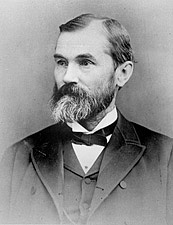
SAUNDERS COUNTY is named for Alvin Saunders, governor of Nebraska Territory during the tumultuous years of 1861-1867. Born to a Kentucky family that later moved to Illinois, Saunders continued west to Mount Pleasant, Iowa, in 1836 at age nineteen. He went into business, studied the law, and became involved in politics. In 1860 he chaired the Iowa delegation to the Republican national convention and successfully worked for Abraham Lincoln’s nomination for president.
On March 26, 1861, President Lincoln appointed Saunders as territorial governor, a position he held until Nebraska’s statehood. Saunders was elected to the United States Senate a decade later and served one term.
He actively promoted the Trans-Mississippi Exposition in Omaha, whose success he proudly witnessed before his death in 1899.
Originally named for John Calhoun, the surveyor general of Kansas and Nebraska, the territorial legislature changed the county’s name to Saunders on January 8, 1862. The first general election of county officers was not held until October 8, 1866.
Governor Alvin Saunders faced issues relating to the Civil War, Indian conflicts on the plains, the organization of the first transcontinental railroad, and the establishment of a new capital.
- Location: Saunders County is located in the U.S. state of Nebraska.
- County Seat: The county seat is Wahoo
- Area: The county covers a total area of approximately 760 square miles, with 750 square miles of land and 9.6 square miles of water
- Population: As of the 2020 Census, the population was 22,278. The estimated population in 2023 is 23,463
- History: Saunders County was established on January 26, 1856, and organized on October 8, 1867. It was named after Alvin Saunders, a territorial governor of Nebraska
- Geography: The county is bordered by the Platte River to the north and east. The terrain consists of low rolling hills that slope towards the river valley
- Economy: The economy is diverse, with significant contributions from agriculture, manufacturing, and services
History
Saunders County was created by the Territorial Legislature on Jan. 26, 1856 and at that time was named Calhoun County. But the name Calhoun was not popular among early settlers in the territory, as a government surveyor by that name was suspected of corruption and graft. So in 1862 the Territorial Legislature changed the county’s name to Saunders, in honor of territorial Gov. Alvin Saunders.
Ashland is believed to be the first settlement in the county. For many years the area stretching north along the Platte River from Ashland to Leshara was home to the Otoe Indians, while the Pawnee Indians were camped in the bluffs in the northern part of the county.
When the first county election was held in 1866, the settlement of Ashland was chosen as the county seat. In 1870 the county’s first courthouse would be built here. Ashland’s status as home to this new county’s government would be short-lived, however, as in 1873 voters chose a more centrally located Wahoo. Within a year a courthouse would be built in the new county seat and stand for the next 30 years. By the beginning of the 20th century the county was in need of a new home for its offices and in 1904 the present courthouse was built at a cost of $87,000.
Located on the east lawn of the courthouse today is a replica of a Mark 14 torpedo, which stands as a memorial to the U.S.S. Wahoo and its crew of 65 who perished during World War II. The submarine was credited with sinking 20 Japanese ships before it was sunk by enemy action on Oct. 11, 1943. Each October a memorial service is held at the courthouse to honor those who gave their lives in submarine warfare.
A frequently asked question is how the county seat received its unique name. There are actually two versions that are used to provide the answer. The first is that the name originates from an Indian word for a medicinal plant known as the “burning bush,” which grew along the banks of the Wahoo Creek. The second explanation is the name is from the word “pahoo,” which means “not very bluffy” terrain.